- Footy Access Exclusive
- Posts
- Global Pathway: Figueroa & Mexican Prospects Show Defining Moments
Global Pathway: Figueroa & Mexican Prospects Show Defining Moments
From Keyrol Figueroa’s looming international decision to standout tournament performances from Justin Díaz and the European training opportunity earned by Alan Hernández and Santiago Cisneros, this week highlights how elite youth prospects are separating themselves through performance, visibility, and strategic pathway choices.

Leo Santos
April 08, 2026
Keyrol Figueroa’s International Decision Looms As Honduras Makes Move

@keyrolfigueroa
The next critical dual-national storyline is taking shape. 19-year-old forward Keyrol Figueroa is reportedly set to meet with the Honduran Football Federation as they prepare a formal plan to integrate him into the senior national team setup. This is not a routine conversation — it’s a targeted recruitment effort centered on one of the most in-form young forwards in the youth international pipeline.
Figueroa’s trajectory has been steady and data-backed. A consistent presence across multiple USYNT cycles, he has built his profile within a highly competitive environment. His development has accelerated further at Liverpool FC Academy, where he’s produced 11 goals in 18 matches this season — an output that signals both efficiency and role clarity as a central attacking piece.

@keyrolfigueroa
There’s also a legacy layer that makes this recruitment uniquely strategic. Figueroa is the son of Maynor Figueroa, one of Honduras’ most capped and respected players. That connection matters — not just emotionally, but structurally. It gives Honduras a cultural entry point and a narrative advantage in what is ultimately a competitive international decision.
From a player pathway perspective, this is about timing. Figueroa is approaching the phase where youth international involvement transitions into senior-level commitment. Honduras is attempting to accelerate that timeline, offering a clearer and potentially faster route to senior minutes — something the U.S. system, given its depth, cannot always guarantee at this stage.

@keyrolfigueroa
For Honduras, the upside is obvious. Securing a forward developing inside a top-tier European academy system would immediately raise the ceiling of their attacking pool. More importantly, it would signal a shift toward proactive dual-national recruitment — a space where smaller federations can create competitive advantages through early engagement and defined pathways.
This is a textbook example of the modern player pathway battle. Elite prospects like Figueroa are no longer just developing — they are being strategically recruited. The federation that presents the clearest plan, fastest opportunity, and strongest identity fit often wins. For players and families navigating this process, the takeaway is simple: development is only half the equation — decision-making is the other.
Justin Díaz Breakouts On Global Stage With Dominant MIC Tournament

MIC Football
Justin Díaz delivered one of the most impactful performances at this year’s MIC Tournament, finishing as the top scorer with nine goals. For a 2012-born forward, producing at that level in one of Europe’s most competitive youth environments immediately elevates his profile within the global scouting ecosystem.
The context makes the output even more significant. Díaz outperformed elite peers from top academies, including Fode Diallo Conde of FC Barcelona and Filippo Amadio of Juventus FC. This wasn’t isolated production — it was sustained impact against some of the most technically advanced players in his age group.

LA Galaxy
Díaz played a central role in LA Galaxy Academy’s run to the final. The group recorded statement wins over Sportivo Belgrano, Girona FC, and Bayer Leverkusen — a gauntlet of diverse playing styles that tested adaptability as much as talent. Their run ultimately ended in a narrow 1–0 loss to Atlético Madrid in the final.
From a development lens, Díaz’s performance highlights early traits that translate: goal efficiency, movement inside the box, and the ability to produce under tournament pressure. These environments compress games into short windows, making consistency and recovery as important as raw talent — key indicators scouts track closely at the U14 level.

LA Galaxy
For the LA Galaxy system, this is validation. Competing and producing against top European academies reinforces the credibility of MLS youth development pathways in international settings. It also reflects a growing trend: American prospects are no longer just participating in elite tournaments — they are dictating outcomes.
Breakout performances at global youth tournaments often serve as early inflection points in a player’s pathway. For Díaz, this is visibility acceleration. He’s now firmly on the radar in a highly competitive age group. For players and families, the takeaway is clear: elite tournaments are not just exposure events — they are separation moments where performance against top competition reshapes trajectory.
Hernández & Cisneros Take Next Step After Olympia Future Cup
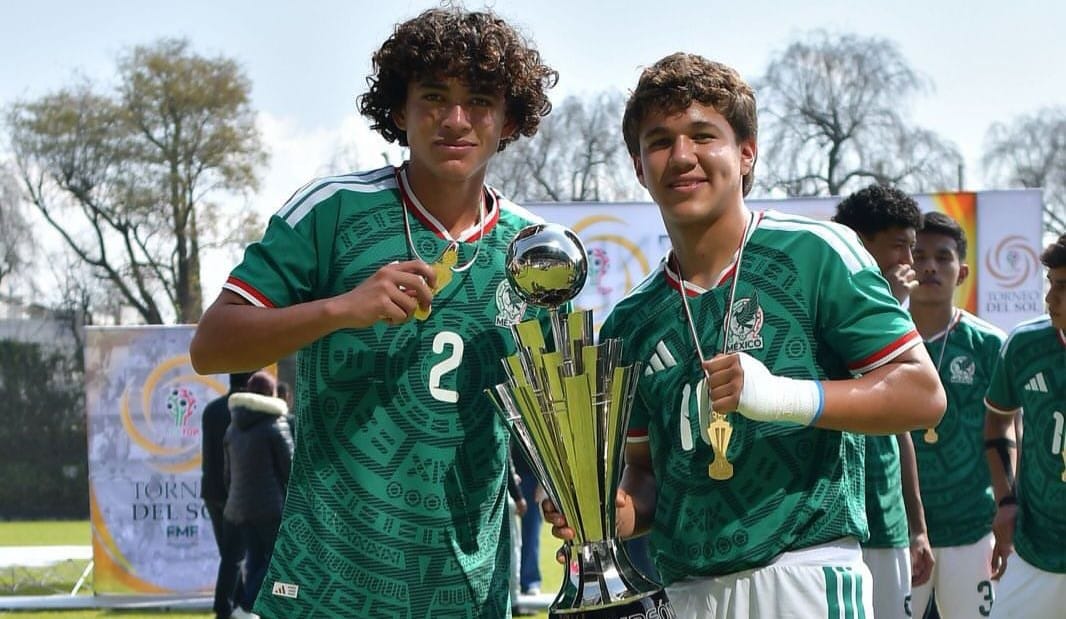
2009-born prospects Alan Hernández and delivered high-level performances at the Olympia Future Cup, representing Future United against some of the most competitive academies in world football. In a tournament built for evaluation, both players consistently met the level.
The pair, developed within Club León and integrated into the Mexico U17 National Team setup, showed traits aligned with international standards. Hernández, operating from a fullback role, added two goals —highlighting his ability to impact both phases and project forward in modern wide defensive roles.

Their performances have already translated into opportunity. Both players have been invited to train with LASK for a two-week period, offering direct exposure to a European professional environment. These short-term integrations are increasingly used as evaluation windows, giving clubs insight into adaptability, training intensity, and tactical processing.
From a pathway perspective, this is a critical development phase. Moving from domestic success into international validation and then into European training environments represents a clear progression model. The ability to handle each step without performance drop-off is what separates long-term prospects from early standouts.

For Mexico’s development pipeline, this reflects continued strength in producing technically capable, tactically flexible players ready for international benchmarks. More importantly, it shows a willingness from European clubs to engage earlier in the identification process, particularly with players who demonstrate versatility and game intelligence.
This is how modern pathways are built. Performance at elite youth tournaments is followed immediately by international training opportunities. For Hernández and Cisneros, this is not just recognition; it’s a real-time test of readiness for the European game. Visibility must convert into opportunity, and opportunity must be maximized quickly to stay on an upward trajectory.